Maybrook House
A Decade of Decay & Neglect.

#Bletchley Deserves Better
Better than MKCC Neglect
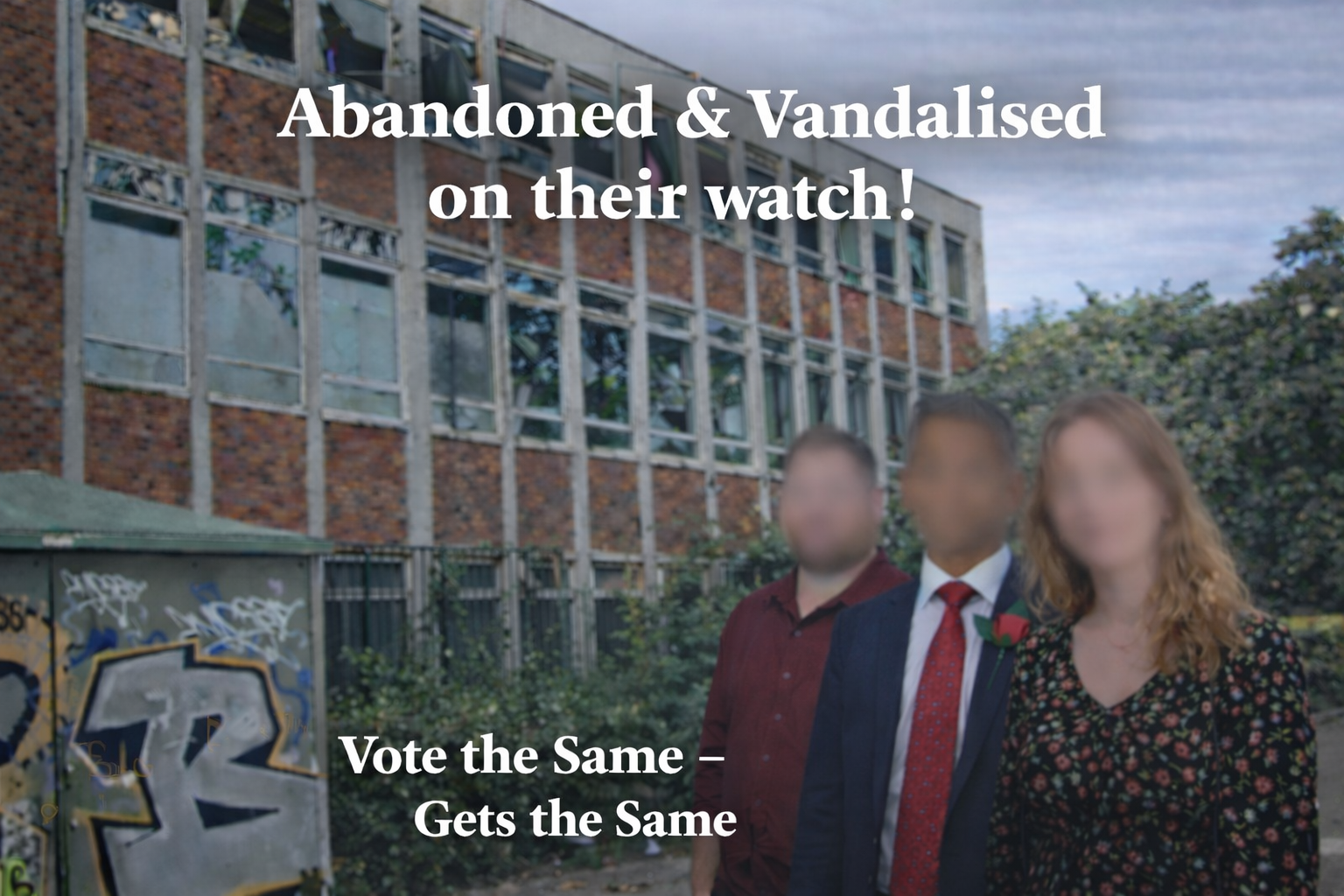

Maybrook House
MKCC a Case Study in Neglect
For many residents living near Maybrook House on Queensway, the building has become a symbol of something far bigger than a single planning decision. It represents a growing concern that MKCC is failing to actively manage development in Bletchley — and that local people are left to deal with the consequences.
A Building Left to Rot
Once a functioning employment and public service site, Maybrook House has spent years in a state of uncertainty. Vacant for long periods, poorly maintained, and visually deteriorating, the building has blighted a key stretch of Queensway. During this time, residents have repeatedly raised concerns about security, anti-social behaviour, visual decline, and a general sense of neglect.
Yet meaningful intervention from MKCC has been noticeably absent.
Has a derelict or long-term vacant building been allowed to blight your area? Tell us your experience
Information
Planning by Default, Not Design
What has happened at Maybrook House is not the result of a proactive, place-led regeneration strategy. Instead, it has largely been driven by “prior approval” planning routes a process that deliberately limits scrutiny, public involvement and democratic oversight.
While technically lawful, this approach has allowed major changes, including conversion to residential use, to go ahead without any joined-up thinking about parking, local infrastructure, community impact or the cumulative pressure on local services.
Impact on Nearby Residents
Residents living in close proximity have experienced a range of knock-on effects:
-
Increased parking pressure on already overstretched streets
-
Concerns about waste storage, servicing, and maintenance
-
Ongoing uncertainty about site management and standards
-
Loss of confidence that complaints or representations make any difference
Crucially, many feel they were consulted too late — or not meaningfully at all.
A Wider Pattern in Bletchley
Maybrook House is not an isolated case. It sits alongside other examples in Bletchley where long-term vacancies, weak enforcement, and hands-off oversight have allowed problems to fester before being quietly reclassified as “regeneration”.
Residents are not anti-development. What they object to is poorly managed development, where impacts are ignored and accountability is blurred.
Residents are Against -Dereliction & Urban decay
Where Were MKCC?
MKCC has statutory powers to intervene earlier — through enforcement, proactive asset management, and stronger engagement with communities. In the case of Maybrook House, those powers appear to have been used too little, too late, or not at all.
The result is a sense that residents are expected to simply absorb the disruption, while the council moves on to the next headline project.
A Lesson Still Unlearned
If MKCC is serious about restoring trust in Bletchley, it must start learning from cases like Maybrook House:
-
Early intervention rather than reactive approval
-
Genuine engagement with those most affected
-
Clear accountability for buildings left to decline
-
A shift from box-ticking compliance to active place stewardship
Until then, Maybrook House will stand as a reminder that when councils fail to manage change properly, it is local residents — not decision-makers — who live with the consequences every day.

Planning Permission: A False Promise?
Why has Maybrook House been left to rot for so long?
Because MKCC has allowed it.
For over a decade, no pressure, no enforcement, no vision and no urgency has been applied to one of Bletchley’s most prominent buildings. While CMK receives constant investment and attention, Bletchley is left with dereliction and excuses. Absentee ownership, speculative land banking, and a total lack of action from MKCC have kept Maybrook frozen in decay.
Maybrook House is not just an empty building — it is the symbol of MKCC’s long-term neglect of Bletchley & Fenny Stratford, the town that helped win WWII but has been abandoned in the peace.
Maybrook House – A Timeline of Neglect
How Did It Come to This?
2010–2015:
Building begins to visibly decline. No strategic intervention from MKCC.
2016–2018:
Potential redevelopment discussions surface but go nowhere.
MKCC fails to use enforcement powers (Section 215, CPO).
2019:
Structural condition deteriorates. Still no pressure applied to owners.
2020:
Bletchley receives £22.7m Town Deal funding — Maybrook not prioritised.
2021–2022:
Building remains derelict. Public complaints grow. No MKCC action.
2023:
MKCC again fails to include Maybrook in any regeneration mandate.
No enforcement, no incentives, no deadlines.
2024–2025:
Still no development. No meaningful update.
The building continues to decay, reflecting years of policy failure.
2026 (Today):
Maybrook House remains the clearest evidence that MKCC has
no strategic plan, no urgency, and no willingness to use its powers
to protect or revitalise Bletchley.
#BletchleyDeservesBetter

Demand Better for Bletchley
Are you a resident of Bletchley & Fenny Stratford, tired of the abandoned and derelict commercial buildings that blight our environment? Maybrook House is a prime example of this issue, impacting our community and its potential.
Bletchley Deserves Better. We need to hold MKCC accountable for the state of our town. We need to demand action on derelict buildings like Maybrook House. Join us in calling for a better future for Bletchley & Fenny Stratford.